
Total Fertility Rate
In the last few decades there have been significant decreases in world fertility rates. The replacement fertility rate is roughly 2.1 births per woman for most industrialized countries but higher for many less developed nations. The Total Fertility Rate (TFR) of a population is the average number of children that would be born to a woman over her lifetime.
The chart below shows the World TFR in columns of 5 years, starting in 1950. The TFR for 2009 and 2010 are estimated. Take a look at the TFR chart below and the other statistics and join me in a discussion of what some of the trends and numbers may mean. For more insight into population trends try playing with the population database provided by the United Nations. Since writing this post the database has been updated and I now link to the latest available information.

World Total Fertility Rate 1950 to 2010
Crude Birth and Death Rates
I will show you next a chart with world birth and death rates plotted together. This may prove useful to the discussion later. The Crude Birth Rate is simply the number of births over a given period divided by the person-years lived by the population over that period. It is expressed as number of births per 1,000 population. Likewise the Crude Death Rate is the number of deaths over a given period divided by the person-years lived by the population over that period. It is expressed as number of deaths per 1,000 population.
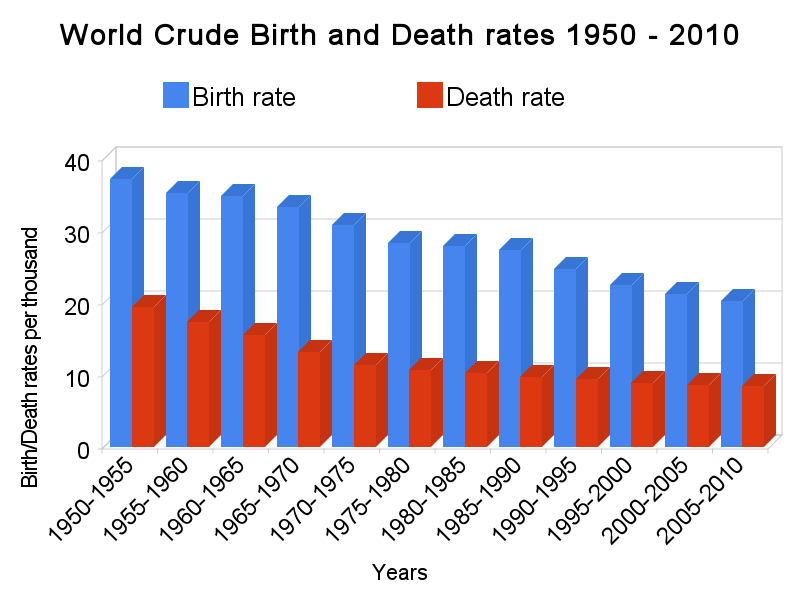
World crude birth and death rates 1950-2010
A Russian Demographic Example
This chart shows the Russian Federation’s demographic crisis quite plainly. All European countries have a TFR less than 2.1 and Russia’s at 1.37 is not the lowest. What is interesting about Russia is it has a sizable population and so their 12.3 million people loss since 1992 (offset by 5.7 million immigrants) is still large, even for a nation of 142 million. Today Russians are diminishing at the rate of over 700,000 a year. One wonders what the effect would be on any nation that suffers sustained population loss.

Russian crude birth and death rates 1950-2010
Decades Long Fertility Decrease
In my chart of world TFR there is plainly a decrease in every 5 year span since the early sixties. The rate of decline seems to be lessening in the last fifteen years but the trend is definitely downwards. The United Nations projects that by 2050 the World TFR will stand at 2.02. This is below replacement level for developed nations and well below a third world country.
Why Population Increases As Fertility Declines
The world birth/death rate chart shows births well above deaths, hence world population is increasing even as TFR is decreasing. Consider that between 1950 and 1955 the death rate was 52% of the birth rate. By 2005 to 2010 the death rate had dropped to 42% of the birth rate. However, even as the death rate drops so too does the birth rate. So why is the world population increasing even as the fertility rate is decreasing? Well, on average, each generation is having fewer children than the previous generation. That is explained by the fertility decrease.
To still have more births than deaths amid a fertility decline is easily accounted for in the decades long delay in the deaths of the parents and grandparents of newly born children. Hence even as the birth rate falls the parents who produced offspring are still alive in most cases and so the death rate is lower. This is called Demographic Momentum. After a number of decades the parents and grandparents die and their children now produce less babies as forecast by the TFR. Population decreases will now begin to appear as in the case of Russia when deaths outnumber births. It is then that the population drops will be in the millions.
Adverse Effects
One adverse effect of a declining population for the young is increased social and economic pressure. They will have to support an infrastructure with costly, intensive care for the oldest among their population. Labor shortages can occur which may cripple labor-intensive sectors of the economy. The decade long economic stagnation of Japan and Germany is linked to demographic problems. Russia has begun a 10-year program to stop the large decline in their population by offering financial incentives and subsidies to encourage women to have children. Australia, France, Italy, Poland, Japan, and Singapore offer thousands of dollars for each baby and regular payments and care for the child.
It is evident that a number of countries see declining birth rates as a serious issue — enough to offer incentives for reproduction. This is not going away anytime soon, especially for nations that have difficulty attracting immigrants. The United States would have a declining population if not for immigration. If the U.S. birth and death rates ever become like Russia’s you will hear more than you ever wanted to know about the total fertility rate.
A Third Way
Phillip Longman of the New America Foundation writes briefly of A Third Way. He states that “a planet that grays indefinitely is clearly asking for trouble.” One alternative to our current aging populations “involves massive state intervention designed to smooth the tensions between work and family life to enable women to have more children without steep financial setbacks.” Longman writes that “so far, countries that have followed this approach have achieved only very modest success.”
Longman then asks: “So is there a third way?”
Yes, though we aren’t quite sure how to get there. The trick will be restoring what, in the days of family-owned farms and small businesses, was once true: that babies are an asset rather than a burden. Imagine a society in which parents get to keep more of the human capital they form by investing in their children. Imagine a society in which the family is no longer just a consumer unit, but a productive enterprise. The society that figures out how to restore the economic foundation of the family will own the future. The alternative is poor and gray indeed. (Phillip Longman, “Think Again: Global Aging,” New America Foundation, October 13, 2010, last paragraph)
A Proclamation to the World
A fascinating document, in support of the family, flowered into existence on 23 September 1995. Entitled The Family: A Proclamation to the World, it was first read in a general Relief Society conference.
The proclamation begins by solemnly proclaiming that marriage between a man and a woman is ordained of God and that the family is central to the Creator’s plan for the eternal destiny of His children. Further, we all are created in God’s image and that gender is an essential part of human identity before, during, and after life on Earth. A summary is outlined of the premortal realm, perpetuation of family relationships beyond the grave, and of temple ordinances and covenants. Now here is the part that most pertains to our discussion:
The first commandment that God gave to Adam and Eve pertained to their potential for parenthood as husband and wife. We declare that God’s commandment for His children to multiply and replenish the earth remains in force. We further declare that God has commanded that the sacred powers of procreation are to be employed only between man and woman, lawfully wedded as husband and wife.
The proclamation continues by identifying parental responsibilities in the rearing of children. To teach them to love and serve one another, to observe the commandments of God, and to obey the law. A formula for happiness and for a successful marriage is detailed. And would a proclamation be complete without a warning?
We warn that individuals who violate covenants of chastity, who abuse spouse or offspring, or who fail to fulfill family responsibilities will one day stand accountable before God. Further, we warn that the disintegration of the family will bring upon individuals, communities, and nations the calamities foretold by ancient and modern prophets.
We call upon responsible citizens and officers of government everywhere to promote those measures designed to maintain and strengthen the family as the fundamental unit of society.
Summary
For decades our minds were filled with government propaganda of a world starving to death and grossly overpopulated with the West running out of food. Even today we hear similar cries. I find it ironic that many of these same governments are now offering thousands of dollars to their populace if they would just have a baby — or maybe two, or three. My wife and children — and now grandchildren are a constant source of joy to me. I am grateful that I followed the wise counsel of religious leaders (and ignored the politicians and “experts”) many years ago.
I am a software engineer by trade and know very little about world fertility rates. But the best way to learn is to write about it and discuss it. I look forward to your comments whether or not you agree with me.
Sources
- Population Division of the Department of Economic and Social Affairs of the United Nations Secretariat, World Population Prospects: The 2008 Revision, Population Database, October 19, 2009. The updated link points to the latest data not available when this post was published.
- Find your country in the UN TFR Ranking or the CIA TFR Ranking.
- World Population Growth Rates: 1950-2050 — From the U.S. Census International Database.
External Articles
This list is updated occasionally, with newer additions listed first.
- About That Overpopulation Problem — Facing a declining world population.
- Daring few challenge China’s 1-child limit — “I don’t think having a baby is any kind of crime.”
- A tale of three islands — World population reaches 7 billion. Don’t panic.
- World population — Boom to bust? — World EFR is 2.4, barely above the 2.3 replacement rate.
- Selective abortions creating imbalanced world population — Unnatural selection.
- Aging Population and Gender Imbalance Challenge China’s One-Child Policy — But no change.
- The End of Japan as an Industrial Power? — Japan’s workers will drop by 20% in 20 years.
- Global Aging And The Crisis Of The 2020’s — Population trends mean a more dominant US role.
- India’s Secret Weapon in its Economic Race With China: Demographics — When? Around 2030.
- Think Again: Global Aging — How did the world get so old, so fast?
- Rumkin.com Population Counter — Watch the Russian population decreasing.
- Population decline — Economic consequences. Wikipedia.
- Population Growth Rates — Pick your own countries to compare with Google Public Data Explorer
- Realities of the Population Explosion — Written almost 40 years ago.
- Why Japan Isn’t Rising — Japan’s population projected to fall 38 million by 2055.
- Japan’s children population at new record low — 29th straight year of fewer children.
- China’s Population to Peak in 2026 — Peak is earlier and lower than previously projected.
- Perfect population storm on horizon — New Zealand’s falling birthrate and emigrating workers.
- Taiwan’s sinking birth rate threatens productivity — Taiwan scrambling to raise birth rate.
- Have more babies — Singapore Prime Minister calls on couples to have more children.
- The Birth Dearth — Loss of markets due to a declining population.
- The Population Surprise — Population greatly affected by human values.
- Don’t blame the babies — It is the bureaucrats, not babies, who are to blame.
- The ‘population bomb’ has fizzled — Underpopulation causes greater alarm than overpopulation.
- Population: Arguments for and against growth abound — Predictions of starvation have been wrong.
Photo Credit: Adelaide

i think these are the effect of modern culture people are not interested to become parents now a days
Your concern about falling birthrates is overdone because you look mainly at the economic value of rising population. What about Earth’s environment? Do Christians care about rainforest loss, the coral reefs, CO2 buildup, overcrowding, stress, loss of open spaces etc? If these things matter then you should welcome the possibility of population stabilisation, or even a fall.
In any case, the world is still a long way short of population stasis. Even in the UK, our birthrate is bulging due to immigration and overgenerous child benefits.
To be sure, babies are nice to have but there is no scriptural basis for promoting large families or opposing contraception. I rather suspect that Christian fundamentalists allow their obsession with “family” and their dislike of “greenery” to colour their judgement.
Your comment raises some valid questions as well as perpetuating some misconceptions. Perhaps I should respond with a new post as there is quite a lot of ground to cover. However, I will respond to your statement, “…there is no scriptural basis for promoting large families.”
Try Genesis 1:28 and Genesis 9:1.
These commandments have never been repealed. They are still in force. Also consider Doctrine and Covenants 104:17 but note in verse 18 that the abundance has to be shared with the poor and the needy, in compliance with correct welfare principles.
You also might want to look up the United Kingdom birthrates, as I did. Things are not always as they seem.
Thanks for your thoughtful response.
Roger is right 100%. On Earth there should be mort than 1-1,5-2 billions. Just NOW we are within beginning a Grand Catastrophe! God simply forgot to change his recommendation to controversial: ENOUGH TO BREED!
There are a number of significant scriptural references. And, even besides those, there are covenants that members of the LDS Church make in temples that are just as binding and important as they were when Adam and Eve received them in the Garden of Eden, when Noah and Naamah (Noah’s wife) received the same covenants and commandments from God, and as when Abram and Sarai at ages 99 and 89 respectively received these same covenants (notice that the new names both were given by God, Abram to Abraham and Sarai to Sarah, were of significant change in status. Abram means “exalted father”; Sarai means “little princess”, and Sarah means “great princess” (or queen)?, the commandment to be fruitful, to multiply and replenish (fill) the earth were given, and given again.
Before Moses sent the Israelites into the promised land, he told them (from God)—
Hear therefore, O Israel, and observe to do it; that it may be well with thee, and that YE MAY INCREASE MIGHTILY, as the LORD God of thy fathers hath promised thee, in the land that floweth with milk and honey.
—Deuteronomy 6:3
“Ye”, of course, is the plural form of ‘you’. If your LDS, you’re ‘Israel’. And that commandment has been kept when Israel has valiant. “And now, behold, it came to pass that the people of Nephi did wax strong, and DID MULTIPLY EXCEEDINGLY FAST, and became an exceedingly fair and delightsome people.”
—Book of Mormon | 4 Nephi 1:10
The Lord, via Isaiah (circa 750 – 700 B.C.) made this important point—
For thus saith the LORD that created the heavens; God himself that formed the earth and made it; he hath established it, he created it not in vain, he formed it to be inhabited…
—Isaiah 45:18
D&C 104:18, as Rickety pointed out, reiterates that God has made ample preparations for people on earth. He knew what he was doing. He knew how many people this earth would have. It is indeed a matter of stewardship. If there are shortages, then they are man-made, as in men being bad stewards. How much grain is grown that could feed bellies, and rather is used by brewers of beer? Way, way too much!
Those who trust in the “arm of flesh” and the “mind of man”, and don’t trust in God, in his commandments, in his foreknowledge, in his omnipotence, are faithless followers of God.
http://www.overpopulationisamyth.com/
if you read this you’ll understand
Regarding shortages, 20 years ago there was 3 times as much land used for producing food, now it is just left there, and since it is not cultivated it is producing way less oxygen too.
Simple math great-grand fathers had 6 kids (+1 who died young), from 6 marriages only in 4 born kids – totally 8 grandchildren, from these 8 only 7 married there were born 10 great-grand children now do the math backwards, for these 10 kids who share 1 pair of great-grand parents how many other great-grand parents contributed to their existence ? A: another 18 pair. For a simple replacement that means that these kids need to have another at least 28 cousins in order to have a 1-1 replacement after four generations, but there are less than 10 so there is a ~50% decrease after 4 generations, altough you would think starting with 6 kids it means a high increase in population.
The jamed world some people see has nothing to doo with overpopulation, it has to doo with life extension, and with crowded towns and cities, where people are atracted magnetically leaving other areas unpopulated. And on the roads it has a great deal to do with “driving with Hitler”, people who lived the WWII know what I mean.
Excellent points. With demographic momentum you do not see population decreases right away, even with low fertility rates. But it does catch up to a nation in the end. And as you pointed out with your example, demographic momentum then works against you as well as the worker/retired ratio being skewed.
Nicholas Eberstadt, in the excellent 2006 produced documentary ‘Demographic Winter’, points out there, near the beginning of the documentary, that the reason why population has increased so much in the world in the past century, is (certainly) not because people “suddenly started breeding like rabbits,” but rather because “they quit dying like flies”. The reason behind the population boom has been a health explosion (due to antibiotics, vaccines, and a myriad of health improvements, from increased and improved nutrition, sanitation, etc.
My in-laws have 63 grandchildren, and about 110 great-grandchildren (from 12 children). Only one has died, and that due to an auto accident. My parents have 41 grandchildren and 75 or so great-grandchildren. None of them (yet) has died (we have two granddaughters of 11 who have or have had brain cancer; the prognosis for the second one who got it is currently not rosey).
I have personally collected the information on all four great-grandparents of mine (I’m currently 60 years old). Before the end of WWII, especially, many more of my parents’ cousins died, and so did their siblings, aunts and uncles, than have died since. In first world nations, deaths are much more uncommon of those before they reach old age than use to be; and even of those much younger, too.
Your article is intriguing and does reflect an identifiable downward trend in fertility rates. As many as 1 in 6 couple in the U. S. now require medical assistance in order to become pregnant. Because fertility treatments are often expensive, the costs can be prohibitive to many.
Most people still haven’t absorbed the truth and implications of the discovery by the English country parson, Reverend Malthus. He pointed out that the more you have the more you get with a constant birth rate. The power of exponential growth to increase human numbers is such that human natural fertility rates (upper bound about 12 children per woman) would soon lead to trillions of humans and impossiblilities like humans weighing more than the earth. Which means, as Malthus also noticed, that all the potential kids can’t survive–population runs into resources limits. And fairly soon because exponential growth is so powerful. In Malthus’ time about 1/3 of kids died before age 5, worldwide. Using fossil fuels, new technology, plowing up vast new areas, displacing other species, allowed humans to escape limits and grow from 1 billion hungry in 1800 (when Malthus wrote) to 7 billion now. But we are damaging our habitat so long term carrying capacity is being harmed (by soil erosion, climate change, species extinctions and fossil fuel depletion). Half of world food now depends on nitrogen fertilizer made from natural gas–which will probalby get too expensive and/or environmentally damaging to use within less than a century. Exponential growth hits a wall. If fertility rates don’t fall to below replacment levels, mortality rates will rise to keep population in line with what the earth can give us. That’s the choice God gave us: reduce fertility or increase mortality. Malthus called his discovery: “God’s Laws.”
“…1 billion hungry in 1800 (when Malthus wrote) to 7 billion now.”
You seem to be saying that all 7 billion residents of the planet are hungry. Surely not.
I haven’t read through all of the comments, so I don’t know if this has already been said, but just in case, I’m going to say it again:
AMEN!!!
(First time reader by the way)
I think you’re spot on, and I love the fact that you included all off the source doc links at the bottom (I’m a sucker for footnotes, just because) This is a topic that I feel strongly about, and I can’t wait till I have a family of my own so that I can practice what I believe. I hail from a family of eight (Dad, Mom, Four boys, and two adorable girls), and I just love spending time with large families.
I think that the graph that I find the most interesting is the one on Russia. I had no idea that they were that bad, and it’s almost chilling to think that, unless we have a large cultural shift, that’s where America is heading.
Thanks so much for sharing!!
Paul L.
America is actually in good shape demographically when compared with Europe and a lot of Asia countries.
Thanks for stopping by.
And that is why the money flowed here (to the USA), and indeed, what caused the sub-prime mortgage mess. The U.S. was demographically “the leper with the most number of fingers and toes”, as David P. Goldman expressed it in his seminal piece, “Demographics and Depression” written in 2009.
Watch ‘Demographic Winter’ issued in 2006 is available as a single video (just under an hour long) on YouTube.
Relatively, yes, we’re better off replacement wise than Europe, most of Asia, etc. And that is why U.S. currency still is the reserve currency of the world. Russia and China and Brazil and everyone else can complain about it, and try to replace it. But it retains still its value better than any other currency, because of our better record in the human capital dept.
Also look up “The Giant Pool of Money” mp3 and transcript that aired on NPR in 2009. Savings exceed those Ready and Worthy of borrowing, due to the lack of babies that were born in places (like the U.S.) over the past half century or so, to be able to use them (AND pay them back)!
Interestingly, the ONE and ONLY nation with an ‘advanced economy’ that has an average TFR (Total Fertility Replacement) level that is NOT at sub-replacement, is teeny, tiny Israel. And THAT is due because ultra-orthodox Jews AVERAGE about 8.5 children per couple per lifetime. (If only Mormons could do half as well).
NOTE: The number of ‘New Children of Record’ in the Church is at LESS than 1/4 the level it was in 1982. Check the annual statistical reports (always given in April General Conference). You will find that with over 15,000,000 members (as of 2013), we cannot, or have not yet quite matched the number of ‘Children of Record’ of 1982 when LDS Church membership was 1/3 of what it is now, and also, the formula the Church used was altered 6 years ago. They use to subtract ‘Children of Record’ who turned age 9 and had not been baptized from those named and blessed in church. This made the numbers jump up about 30,000 the year they did it. If the old formula was still used, the current number would probably be BELOW 85,000 ‘Children of Record’!
Rickety,
Thanks for publishing the above World Wide TFR’s! That’s valuable.
in my view a tfr of 1.6 is ideal
Declining fertility rates suggest that our governments are putting things in our food to cause infertility.